On July 16, 2026, the Town of Loxahatchee Groves posted a one-line notice on its website: N.E. Road was being paved that day. For most of Palm Beach County, a line like that would pass unnoticed. In Loxahatchee Groves, it is closer to a bulletin. Residents track the paving list the way other neighborhoods track school ratings, because in this town the surface under your tires is not a maintenance footnote. It is a financial history, and it is still being written.
Buyers touring farms here tend to file road condition under curb appeal, somewhere below barn square footage and arena footing. That instinct is wrong for this market specifically. The letter on your road, A, B, C, D, and the rest, tells you who already paid to fix it, how much they paid, and whether the town's obligation to maintain it going forward is contractual or nonexistent. Two farms that look identical on paper, same acreage, same distance to the show grounds, can carry very different exposure depending on which side of that line their road sits.
OGEM: The Surface Under Half The Town
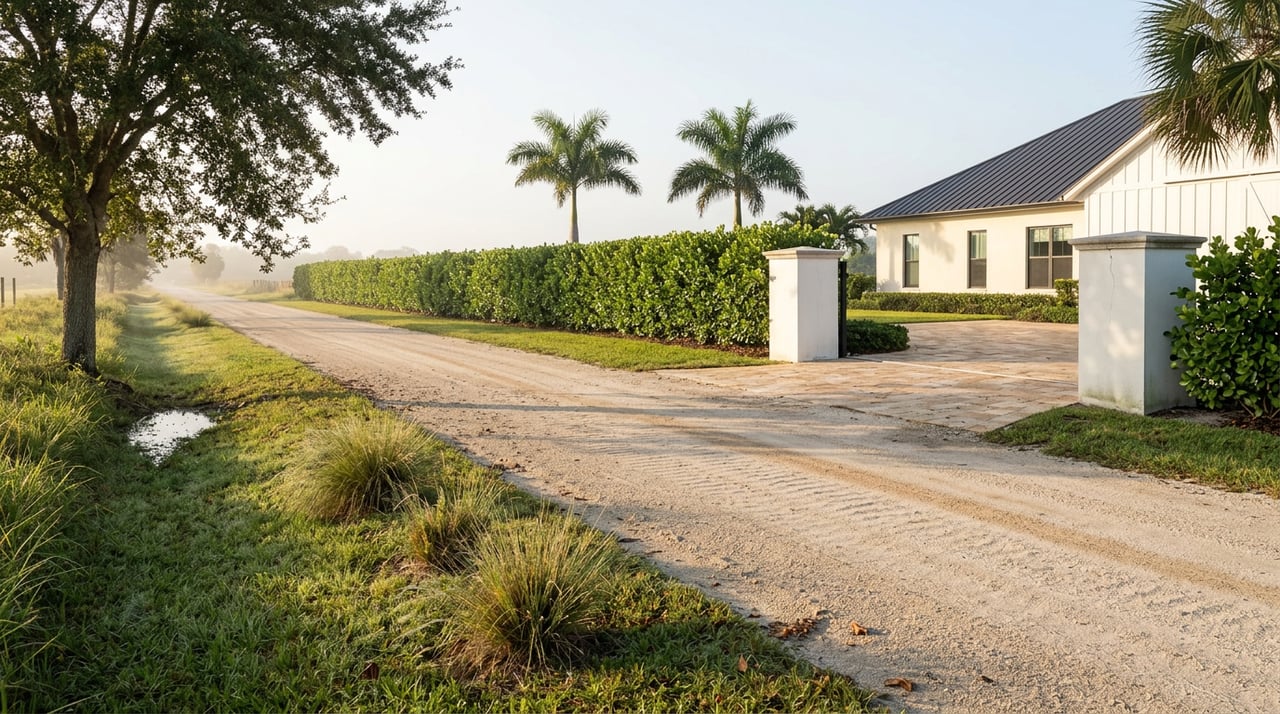
Most of the lettered roads in Loxahatchee Groves were never asphalted in the conventional sense. They were stabilized with a material called Open Grade Emulsion Mixture, known locally as OGEM, a lower-cost alternative to true paving. The appeal was straightforward: OGEM cost less to install, and that lower cost made it easier to secure landowner approval for the special assessments that funded it. The trade-off showed up over time. Several OGEM segments were built without the full drainage work the original design called for, a cost-cutting choice made to keep assessments low enough to pass a vote. Sections washboarded. Drainage swales filled in. By the late 2010s, parts of the network became difficult to pass after heavy rain.
That is the baseline condition a buyer is evaluating when a listing says a farm sits on an unpaved road in the Groves. It is not neglect. It is the direct, traceable result of a funding decision made years earlier by whoever owned the land at the time.
The Vote That Decided Your Road's Fate
The process for converting an OGEM road to true asphalt runs through the Loxahatchee Groves Water Control District, a dependent district of the Town that handles road rights-of-way, easements, and drainage capital projects. Landowners along a given road vote on whether to fund the improvement, and the vote is weighted by acreage: five acres carries five votes. That system means a road's current condition reflects the collective decision of owners who may have sold their land a decade ago. You inherit their vote along with the parcel.
This is worth sitting with before you assume a road will eventually get fixed on its own. The town has been unwinding the OGEM inheritance one contract at a time, but the order and pace depend on Public Works scheduling, budget cycles, and drainage prerequisites, not on a new owner's preference or a purchase contract's timeline.
Same Length, Very Different Bills
The clearest evidence that "paved" doesn't mean one price is sitting in the town's own project records. B Road South, once fully converted, came in at a total project cost of $1,331,103.62, or roughly $832,000 per mile. D Road South, a segment of comparable length paved in 2021, cost roughly $400,000, about half as much for essentially the same distance. In the same year, the Town Council approved a $347,254 contract with Hardrives Inc. to pave two miles of A Road between Okeechobee Boulevard and North Road, complete with speed tables and thermoplastic striping, which works out to under $175,000 per mile.
| Segment | Length | Total cost | Approx. cost per mile |
|---|---|---|---|
| B Road South | comparable length | $1,331,103.62 | ~$832,000 |
| D Road South (2021) | comparable length | ~$400,000 | ~$400,000 |
| A Road (2021, Okeechobee Blvd to North Road) | 2 miles | $347,254 | ~$174,000 |
The gap is not asphalt pricing. It is everything that gets bundled into a given project: drainage retrofits deferred from the original OGEM build, engineering and legal fees tied to resolving easement disputes, developer cost-share arrangements, and change orders that show up only once a crew starts digging. A listing that says a road is paved tells you nothing about which of those costs already got absorbed and which are still sitting in front of the next segment on the list.
The Easement You Can't See From The Driveway
In 2019, the Town Council paused a rock and grading project on B Road after property owners complained that the improved surface had crept onto their land. Councilwoman Lisa El-Ramey, who lives on B Road, told the Town-Crier that years of grading had pushed the road edge onto her property, and that a change in material had left her with a six-inch grade above her original ground level where she previously had a ten-inch grade below it. That shift created a flooding risk on her side of the property line, with no practical way to stop drivers from drifting into what was technically her easement.
A separate dispute on Collecting Canal Road surfaced the same underlying problem from another angle. A resident there told the Town-Crier that the Water Control District had given up its maintenance easement rights to a nursery operating across the canal, and that the nursery's failure to maintain the easement had let trees grow down into the canal itself, a condition the neighboring landowner still lives beside.
Both cases point to the same practical lesson. In Loxahatchee Groves, the recorded easement line and the road as it is actually graded and driven do not always match. A plat from the file cabinet won't tell you where your fence line legally sits today. A current survey will.
Public Road, Private Road, and the Line the District Won't Cross
A Florida Attorney General opinion involving this exact district settled a question that matters more to buyers than it sounds. Palm Beach County Fire-Rescue once asked whether the Water Control District could use its funds to maintain a private road so that emergency crews could reach residents living on it. The opinion concluded that the district may not spend district funds maintaining a private road in which it holds no ownership or easement interest, though the county may step in if the road's owner reimburses the actual cost.
That distinction is the whole ballgame for a certain kind of Groves property. If the road serving your farm was never dedicated to the Town or the Water Control District, no assessment reaches it, no crew grades it, and it does not appear on any paving plan. Maintenance is entirely the owner's responsibility, indefinitely. That is a cost to underwrite before you close, not a surprise to discover after the first named storm washes out your driveway.
What's Actually Happening Right Now
The town is still actively working through its road list. The N.E. Road notice from mid-July 2026 is one line in a Grading Schedule the town posts and updates monthly, with the standard caveat that dates shift for weather, equipment availability, and other conditions on the ground. That means a farm sitting on an unconverted segment today is not necessarily stuck that way, but there is no fixed date to hold anyone to, and the sequence Public Works chooses is not something a buyer's timeline can influence.
The Six Questions Worth Asking Before You Write an Offer
For a working farm in the Groves, road status belongs on the same due diligence list as barn permitting and septic condition. Before you write an offer, get answers to:
- Is the road fronting this parcel OGEM, true asphalt, or still unimproved rock or shell
- Has that road already been assessed, and is the assessment paid off or still being collected against the property
- Is the road dedicated to the Town or the Water Control District, or is it private
- Where does a current survey place the easement line relative to the existing fence, paddock, or driveway apron
- Is this segment on the current Grading Schedule or paving plan, and roughly where in the sequence
- If your trailer route to Okeechobee Boulevard or Southern Boulevard crosses an unconverted segment, what does that add to a routine haul during show season
None of these questions show up on a standard listing sheet. All of them affect what the property is actually worth to you once you own it.
David Welles built his advisory practice on reading exactly this kind of detail before it becomes a closing problem. His background in construction and project management means barn specifications, arena drainage, and road and easement history all get the same technical scrutiny, whether the property is a show-ready compound or a raw acreage parcel in the Groves. If you are evaluating a farm here and want a second set of eyes on what the road actually tells you, Welles Properties is built for this exact conversation.
A Few Direct Questions
Does an unpaved OGEM road affect financing or appraisal? Lenders and appraisers care about access and condition more than surface type on its own. An OGEM road that is well maintained and passable in all weather is different from one that has washboarded past the point of reliable access, and that distinction is worth documenting before an appraisal, not after a low valuation comes back.
Who do I contact to check a specific road's status? The Town of Loxahatchee Groves publishes its current paving plan and monthly Grading Schedule on its official website, and the Town Clerk's office can confirm whether a given segment is dedicated to the Town or the Water Control District.
Are all lettered roads the same condition? No. Some segments have been fully converted to asphalt with drainage rebuilt, others remain OGEM in varying states of repair, and a smaller number are private roads outside the district's authority entirely. Condition has to be verified parcel by parcel.